





What Jar actually does
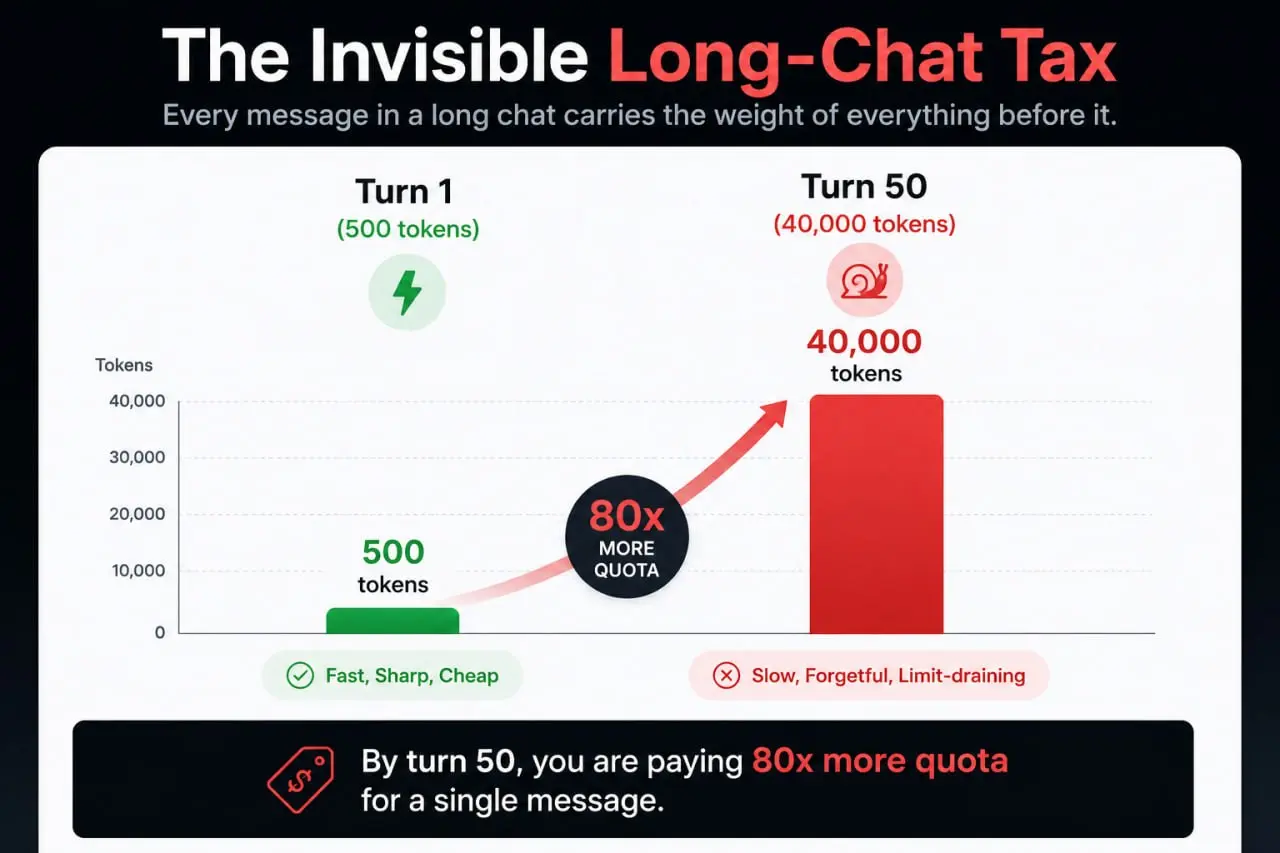
AI chat models are stateless. When you send message #50, the model doesn’t remember messages #1–49 — it re-reads all of them, every single time. That’s why long chats get slow, expensive, and forgetful.
Jar breaks the pattern. You work in short, focused chats. When a chat has done its job, you save a Checkpoint into Jar. Jar consolidates your project into a compact Package — locked decisions, background, next steps — about 2–8 KB. Paste that Package into a fresh chat with any AI, and it’s oriented instantly.
Every chat feels as sharp as chat #1, because every chat starts from a clean summary instead of a noisy history.
The problems Jar solves
“Which chat had that decision?” You’ve got dozens of conversations, most named “New chat”. The pricing decision, the character’s backstory, the API design — they’re in there somewhere. With Jar, decisions live in one Package per project. You don’t search. You just look.
Context rot. Around 30–50 turns in, every AI gets worse at your conversation, not better. It contradicts decisions it made 20 turns ago, forgets names you established at turn 3, repeats itself. Models don’t attend equally across a long window — and the middle, where most of your project logic lives, is where attention is weakest. A Package is curated context that fits well inside the AI’s sharp zone.
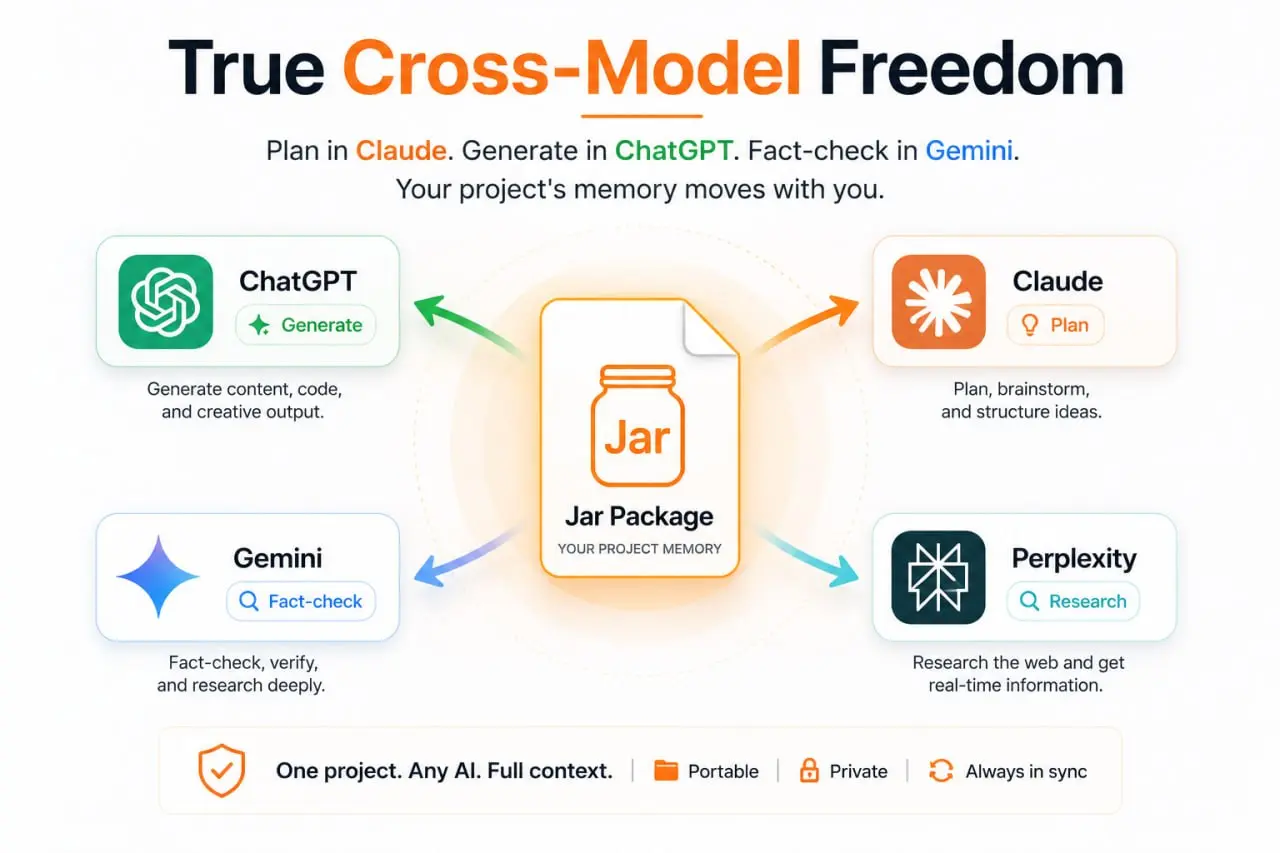
Model lock-in. You picked Claude for reasoning, but now you want ChatGPT for images or Gemini for grounding. Two weeks of project history says you’re staying put. With Jar, model choice becomes turn-by-turn instead of project-by-project — right tool for the task, not one tool for the project.
The blank-chat tax. Every new chat costs 5–10 minutes of re-explaining. So you avoid starting new chats even when you should — which is exactly what causes the problems above. Jar makes starting a new chat free.
Coming back after a break. You went to lunch 30 turns deep. Now you’re re-reading your own chat to reconstruct where you were. Your Package has a next-steps section. Glance, resume.
Vendor risk. Pricing changes, model deprecations, outages, account issues — if your project history lives inside one AI vendor, it’s exposed. Your Jar Package is yours. Export it to markdown, hand it to anything.
The token maths, honestly
Input tokens dominate long conversations, because the whole history gets re-read on every message. Here’s what one message costs as a chat grows (illustrative, at typical mid-tier model input rates):
| Chat turn | Context re-read | Cost of ONE message |
| Turn 1 | ~500 tokens | ₹0.13 |
| Turn 10 | ~5,000 tokens | ₹1.28 |
| Turn 25 | ~15,000 tokens | ₹3.83 |
| Turn 50 | ~40,000 tokens | ₹10.20 |
| Turn 100 | ~90,000 tokens | ₹22.95 |
| Turn 150 | ~150,000 tokens | ₹38.25 |
Turn 50 costs roughly 80× more than turn 1 — for the same size reply.
If you’re on a subscription rather than an API bill, you don’t feel this as money — you feel it as quota. It’s why people hit their limit “after only 20 messages”: those 20 messages were in a chat carrying 100 turns of context.
A Jar Package is ~500–2,000 tokens instead of 40,000–90,000. Realistic saving on long projects: 60–85% fewer tokens burned. Not a magic 20× — the honest mechanism is that you never let a single chat get long enough for the input tax to spiral.
| THE HONEST LIMITATION (keep this in — it builds trust)
Jar doesn’t eliminate the token problem — it disciplines it. If you still write 100-turn chats after using Jar, you’ll still hit context rot and quota burn. Jar’s real value: it makes short focused chats feel as good as long ones, because the starting point is always oriented. It turns the long-chat habit (everyone’s default) into a short-chat habit (genuinely better) without you having to build the discipline yourself. |
Plans
| Plan | Price | Best for |
| Free | ₹0 | Trying the flow — one active project |
| Silver | ₹100/mo | Most real workdays — a few parallel projects |
| Gold | ₹300/mo | Heavy daily use — multiple parallel projects |
| Platinum | ₹500/mo | Teams & power users — lots of parallel projects |
Every paid plan includes: any AI (ChatGPT, Claude, Gemini), the Package + Checkpoint system, and full snapshot history. All plans are 1 month.
How to get started
- Create your free Jar account at jarforai.com — takes a few seconds.
- Come back here and pick your plan (Casual, Creator or Pro).
- Enter your Jar account email at checkout — this is required, it’s the account we upgrade.
- Pay in rupees by UPI, GPay, PhonePe or card.
- Your plan is activated on your Jar account within minutes. We’ll confirm on WhatsApp or email.
FAQ
Do I need a Jar account before buying?
Yes — sign up free at jarforai.com first, then give us that email at checkout. It’s the account we upgrade.
How fast is activation?
Within minutes during working hours. This one isn’t auto-delivered like our key products — a human upgrades your account. You’ll get a confirmation.
Which AIs does it work with?
Any of them. ChatGPT, Claude, Gemini, Grok ,Perplexity — Jar doesn’t plug into them, it hands you a Package you paste in. That’s why it works everywhere and why nothing is locked to one vendor.
Is this a subscription that auto-renews?
No. This is a 1-month plan. When it ends your account returns to Free — nothing is charged automatically. Buy another month whenever you want.
Can I try it first?
Yes. The Free plan runs the full loop with one active project. Buy a plan when you need more room.
Does it store my chats?
Jar stores the Packages and Checkpoints you choose to save — not your raw conversations. You control what goes in.
Need more information about Jar AI? Read our complete guide here


Reviews
There are no reviews yet.