

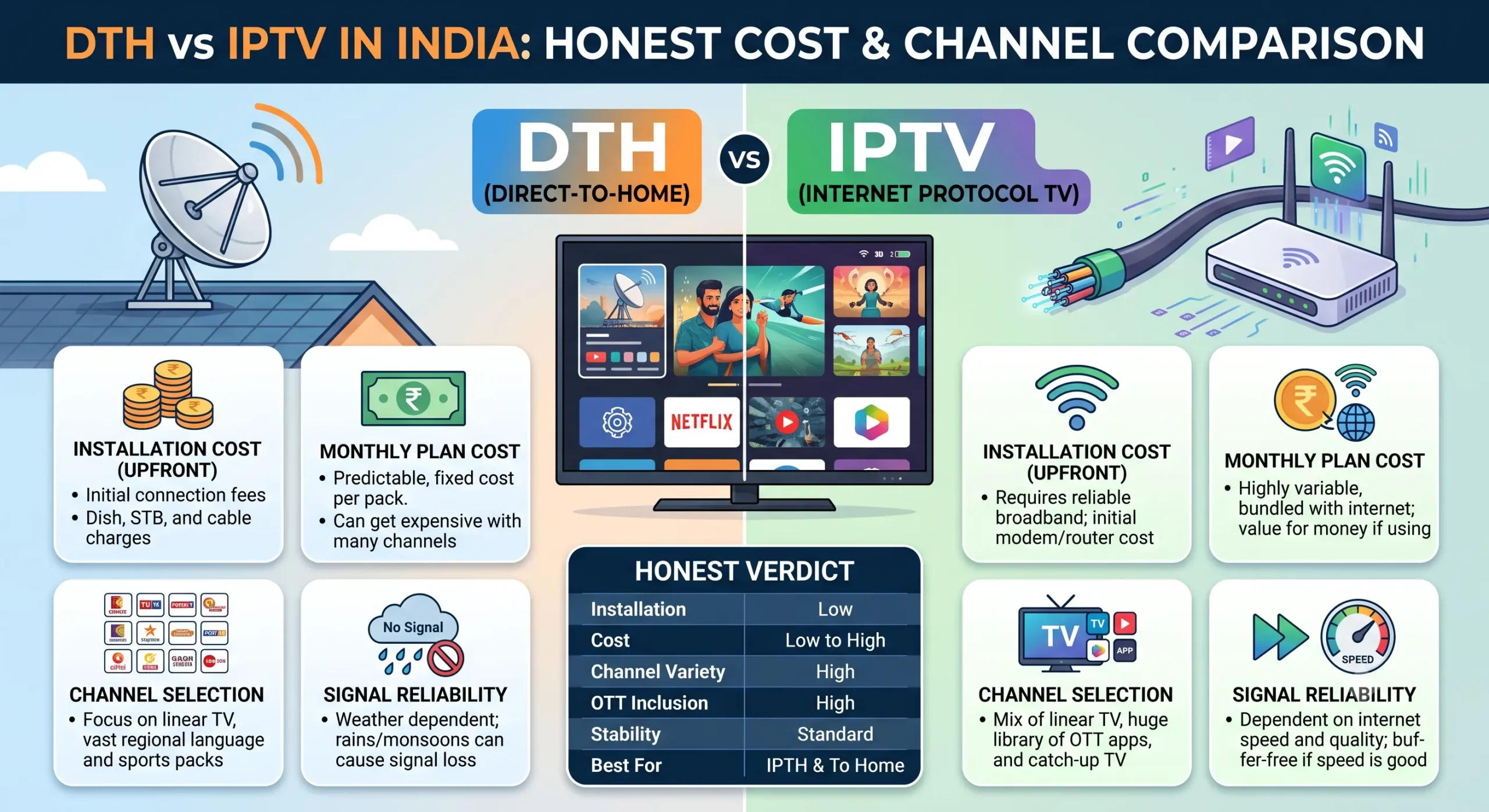
Most families in India pay their monthly cable or satellite television bill purely out of long-standing habit. You click through hundreds of channels every single day, yet you only watch a small handful of sports networks, regional news, or entertainment options. The rest of the bundle sits completely untouched, even though you pay for it every single month.
Traditional television models are facing a massive structural shift across the country. High infrastructure costs, rigid packaging rules, and unnecessary multi-TV premium penalties are forcing households to reconsider their entertainment budgets. If you are exploring the debate surrounding dth vs iptv india, it is time to break down the actual mathematics of cord-cutting.
To see how your current television setup scales over a full calendar year, you can run your monthly statement numbers directly through our free DTH vs IPTV Calculator to map out your potential savings instantly.
The Financial Realities of Traditional DTH Connections
Traditional Direct-to-Home satellite television functions on a multi-layered infrastructure model. You must mount a physical parabolic dish antenna on your rooftop, run coaxial cables through your living space, and attach an external hardware decoder box to every screen.
This physical hardware architecture introduces immediate base costs. Under local regulations, every DTH operator must levy a foundational Network Capacity Fee. This base fee acts as a mandatory rental charge just to keep your line open. It does not include any premium pay channels.
Once you start adding popular high-definition sports packs, movie channels, or regional infotainment bundles, the monthly expense spikes dramatically. If you have a secondary television in your bedroom, operators apply an additional multi-TV capacity charge, effectively billing your household twice for the exact same underlying content streams.
What Exactly Is IPTV and How Does It Operate?
Internet Protocol Television marks a fundamental departure from satellite broadcasts. Instead of capturing radio frequencies from overhead satellites, the video data streams directly through your existing high-speed home broadband connection.
If you already own an Android smart television, a Firestick, or an Apple TV device, you do not need any external set-top boxes. You simply download a secure media player application onto your current hardware. The system translates the incoming digital signal into clear, instant live streams using the exact same fiber pipeline you are already paying for every month.
The Weather Advantage: Surviving the Indian Monsoon
Anyone using traditional satellite television across India knows the deep frustration of heavy weather interference. During the intense monsoon season, thick storm clouds completely block satellite signals, causing immediate on-screen pixelation or total transmission blackouts.
These weather drops frequently occur during major live international sporting events or critical breaking news broadcasts. Because internet-based television relies entirely on physical underground fiber cables running to your home router, ambient atmospheric conditions do not interrupt your viewing experience. Your stream remains perfectly stable as long as your broadband connection is active.
Data Usage Concerns for High-Definition Streaming
While the technical and cost benefits are significant, internet television introduces one critical operational requirement. Streaming high-definition or 4K content uses a substantial amount of network data every hour.
If your household relies on a limited mobile hotspot or a capped broadband plan, switching entirely to internet-based streaming will easily exhaust your allowance. To maintain a smooth experience without buffering, you must ensure your home fiber connection features an unlimited usage policy and holds a steady baseline speed of at least 25 Megabits per second.
Evaluating Your Long-Term Entertainment Budget
The financial gap between these two models expands significantly over a twelve-month period. Traditional setups demand constant plan reconfigurations, hardware maintenance fees, and multi-room surcharges that drain your wallet quietly.
Moving to a modern digital architecture lets you consolidate your home expenses. You clear the ugly wiring from your walls and maximize the value of your monthly internet subscription. You can check the complete baseline costs for various streaming options in our database to ensure you are getting a secure, reliable connection.
Explore the options inside the official keys-shop.in website to evaluate your digital utility tools safely today.
Frequently Asked Questions
Q: Do I need to buy a separate IPTV box to stream live channels?
A: No. If you have an Android TV, Amazon Fire Stick, or real smart display, you can simply run standard media player applications directly from the official application store.
Q: Will my internet television connection freeze if multiple people use the Wi-Fi?
A: If your home broadband bandwidth is low, simultaneous downloads can cause minor buffering. A standard 50 to 100 Mbps fiber line is more than enough to handle multi-device households smoothly.
Q: Can I access local regional language channels through internet television?
A: Yes. Digital streams cover a massive variety of global and localized regional content blocks, frequently outperforming the rigid channel limits of standard satellite providers.
Frequently Asked Questions
What is the main difference between DTH and IPTV?
DTH (Direct-to-Home) uses satellite signals for transmission, while IPTV (Internet Protocol Television) streams content over the internet.
Which is more cost-effective, DTH or IPTV?
The cost-effectiveness depends on your viewing habits and the packages offered by providers. Generally, IPTV can offer more flexible pricing and channel options.
Can I watch live sports on both DTH and IPTV?
Yes, both DTH and IPTV services offer live sports channels, but availability may vary based on the provider and package you choose.
Do I need a special device for IPTV?
Yes, IPTV typically requires a compatible device such as a smart TV, streaming box, or a smartphone with the appropriate app.
Is there a difference in picture quality between DTH and IPTV?
Picture quality can vary based on the service provider and your internet speed for IPTV, while DTH generally provides consistent quality through satellite signals.

